Showing posts with label ITEC. Show all posts

Tuesday, June 4, 2019

Five years

April marked FIVE YEARS since we sold it all and hit the road, and at this point we are currently living in Ecuador. How did we wind up here? I'll come back to that. We ended up spending four and a half years living in an RV full-time while traveling the US and Canada soaking in the gorgeous views and history North America has to offer. Our plan for year 5 was to spend more time exploring other countries, but that was postponed to spend much-needed time with family. We picked a spot near family that we could use as a home base when we aren't traveling. Last year we spent 6 months at our home base and 6 months traveling- our longest trip away being a roadtrip from the east coast to Las Vegas and back, plus a couple trips up to Ohio. We added two new states this year: Oklahoma and Arkansas, which leaves us 3 states short of the full deck: Minnesota, North Dakota and, weirdly, South Carolina.

This year we dug for diamonds in Arkansas, discovered a new favorite hike at Tent Rocks in New Mexico. We watched our kids gaze for the first time into the depths of the Grand Canyon. We kayaked with manatees and monkeys in Florida. In Ohio we held BlueJays and the largest bullfrog in history, ok, maybe not, but he was huge. I saw a Snowy Owl, a Kirtland's Warbler and a Shoebill Stork this year. We hosted two exchange students, one from Spain and the other from China.
We became active in recruiting potential bone marrow donors after meeting a very special mom and little boy who are desperately looking for his match. (See if you're a match HERE.)
We had some interesting things happen, like the time Asher had a scorpion on his neck, and when the kids were invited by a pilot into the cockpit on one of our flights.

Back at the cabin, we adopted two snakes (a ball python and a baby corn snake), a black bear became a regular visitor, a dog vs water moccasin showdown resulted in the death of both participants, and an alligator walked thru our yard!
We hugged our sweet Bella for the last time and left our sweet Asa with my mom. That was super hard, but again, we expected to be mostly traveling internationally which would not only be difficult, but not in her best interest.

We toured the offices of ITEC where they opened our eyes to a new way of sharing the gospel. This lead to an opportunity for us to join ITEC on a trip to Kenya to train locals while the twins enjoyed quality time with their grandparents and cousins. While there we learned much about Kenyan and Maasi culture. We went on safari and saw giraffes, monkeys, rhinos, and of course amazing birds. Then we spent time in Uganda with old friends.

We've been wanting to learn Spanish and give the kids more cultural experiences. An opportunity arose for us to help at ITEC Ecuador for 6 months, so here we are. Details of our life here will follow in future posts.

Tuesday, November 13, 2018

Nairobi & Kitengela {Kenya}


Four of us arrived in Kenya four days ahead of the training to attend the annual Global Missions Health Conference in Nairobi. The focus of the 2018 conference is serving the whole person- mind, body, spirit, to inspire lasting transformation. We set up a table and made ourselves available to explain what ITEC does and how Christ followers around the world can address the physical needs of those in their community as a way to love them and discuss their spiritual needs.


We were able to attend sessions on a variety of topics and join in the morning worship.


Our hotel was only a ten minute walk from the conference.
We had a nice room with bug nets, which we were grateful for!


A couple times we walked thru Uhuru park on our way to the conference. 
Some beautiful birds hang out there, like this Superb Starling and Giant Kingfisher.


Second to the Black Kite, the Marabou Stork is the most common bird seen in Nairobi. These 5 foot tall birds are hard-to-miss with their 9 foot wingspan and the fact that they nest in trees over the sidewalks! The fact that they are bald and have a large pink gular sac attached to their neck would probably disqualify them from being considered beautiful to most people. Add the fact they eat anything from trash to flamingos, and it's losing whatever endearing qualities it may have had left. While not a local favorite, it's still an interesting bird.

I spotted quite a bit of wildlife right outside the hotel. The African Wildcat is mainly nocturnal, so I was lucky to spot one early one morning while looking for birds.


Variable Sunbird (above)  African Paradise Flycatcher (below)

I love the trees in Kenya, especially the Acacia trees, but these palms were a treat.

We had a few hours free before leaving Nairobi, so while the rest of the team caught up on sleep, we grabbed a taxi to the Nairobi Arboretum to see some monkeys and birds. Shortly after arriving, we spotted a large group of Vervet Monkeys jumping out of bushes, falling from trees, wrestling each other and just, well, monkeying around. They were a joy to watch.


We saw one monkey we believe was a Sykes, later in the forest by itself. 
Something was clearly snacking on this colorful fruit. I haven't been able to figure out what it is.

More cool trees- A crazy, tall cactus with a tree trunk, the thickest bamboo we've ever seen and a very twisted tree.


Then it was time to leave Nairobi and head south to a town called Kitengela where we'd be training people for a week. I had been picturing us staying in huts out in a jungle, so imagine my surprise when we pulled up to this hotel...


...and were shown to this room!

View from our balcony

Seeing people carrying large, heavy items on their head really intrigues me.
The must possess much strength and balance.

We ate lunch everyday at a place just outside the hospital. It was pretty much the same thing everyday, but after a couple days I realized I could replace the red oily beef with beans. The rolled bread is called Chapati, made from flour, water and a tiny bit of salt and sugar.  I tried a different flavor of Fanta each day. Turns out pineapple is my favorite.


Towards the end of our training, we moved to the University where IMED and IFILM were training, and where we had been eating dinner every night.

Checking out the view from the roof.

Dinner was pretty much the same thing every night: Sukuma (collared greens), chicken, rice and Ugali (a cornmeal porridge made to a consistency similar to very thick mashed potatoes). We also tried Mukimo, green mashed potatoes with corn mixed in and Samosas - spicy meat inside a pastry pocket. 

This gorgeous kitty came to visit the dining hall just about every night. 
Wish I could have taken him home with me!

Sometime we rode the van from the hospital to the university, but because the the road was rough, we could walk it in just about the same amount of time. So sometimes we chose that instead.


Tuk tuks are a super popular mode of transportation. I think they sound like the Jetsons spaceships flying by.


Lines on the roads are mere suggestions. A two lane road is often treated as a five lane road.

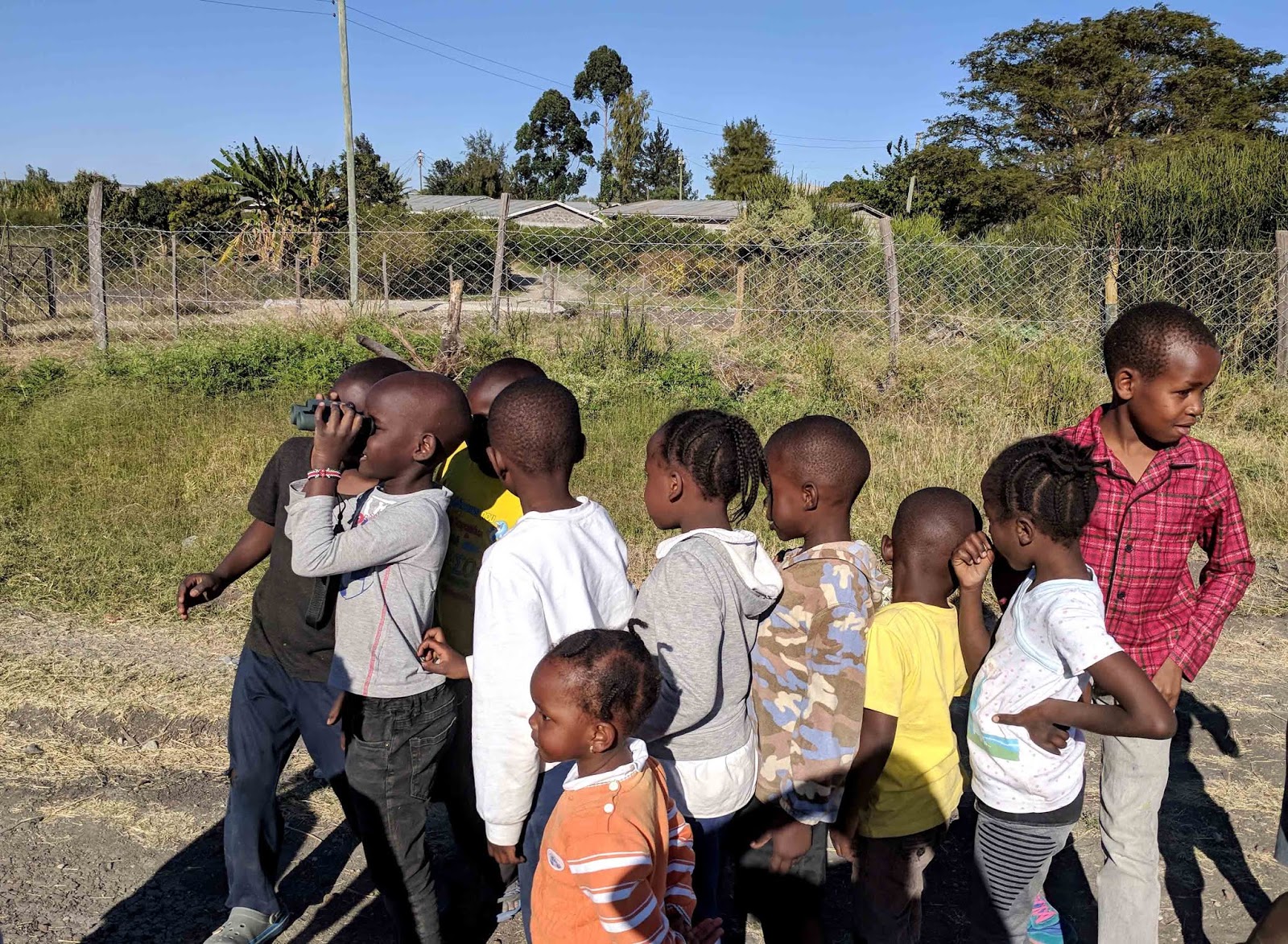
And the children, oh the children! One late afternoon I was walking around outside our tent looking for birds when some children, just home from school, walked past me a couple times keeping their eyes on me. I smiled and waived.


On their third pass I explained I was looking at birds and invited them to take a look thru my binoculars. They continued on their way, but not before asking if they'd see me the following day. They did, and the day after that, and the day after that. They loved having their photo taken.


There were two children in particular that always came looking for me. Our last day at the hospital was Saturday and the children didn't have school, so they found me at 8am and asked, "When can we go look for birds?" I quizzed them on the birds I'd taught them earlier in the week and was happy to hear they were remembering some of the names. At lunch on Saturday, I had a large crowd of children wanting to look at birds with me. I passed my binoculars and watched with a smile on my face as one boy took charge. He had everyone form a line and then he stood at the front and would tell the one with the binoculars when their time was up.


Hateem really grabbed hold of my heart. This little six year old is such a sweet boy and I loved how interested he was in the birds I showed him. Before we left, he ran home and returned with a phone so he could take a photo of us together. I really miss this little guy.

Monday, November 5, 2018

The Story of Redemption that Lead Us to Kenya {ITEC}


About six months ago we were introduced to an organization that spun my view of missions upside down. When I thought of short-term missions, I envisioned people volunteering their time, donating supplies and/or money, building things or helping those with medical issues for a week or so. 

That is not ITEC.

To understand why ITEC doesn't do those type of short term missions, you have to go way back. 
You see, ITEC was born from the collision of two worlds. *

Steve Saint, the founder, has personally seen the unintended, but very real harm that comes from traditional short-term missions. He was a 5 year old child living in Ecuador when his father a missionary, along with four others, was killed by the Waodani tribe. In a story of redemption that only God could write, not only did Steve and his family end up moving into the jungle, but he ended up being raised by the same men who killed his father. As you can imagine, the news of five missionaries being killed by a notoriously savage tribe, spread quickly throughout the world. Over time this tribe became a focus for missions. People came in love to build things, give supplies and do things for the Waodani people. After Steve had been living in the United States for 20-some years, the Waodani tribe had a request. They wanted Steve to move back to Ecuador with his wife and four teenagers. Upon his return Steve was shocked to see the negative impact of short-term missions on the Waodani people. The missionary-built church was falling apart. When questioning them, he realized in their culture a structure is owned by its builder, so they believed they had no right to perform the needed repairs. The elders no longer felt competent to baptize believers even though those same men baptized Steve over 30 years before. Now they waited for visiting missionaries to do it for them.

What happened? This previously self-sustaining, independent tribe was now completely dependent on missionaries. Ouch.

Steve was the first to publish a book highlighting the unintended consequences of short-term missions. I HIGHLY RECOMMEND reading The Great Omission by Steve Saint. It should be required reading before any type of mission/service trip.

The tribe asked Steve to teach them skills so they no longer had to rely on missionaries to come and do what they were fully capable of doing for themselves. And ITEC was born.

ITEC's mission is to train and equip indigenous Christ-followers to care for the physical needs of their people as a door opener for Christ. Six different trainings are currently available:

I-MED .  Medical training- Basic hygiene, taking vital signs, first aid, wound care, testing and treating of local sicknesses like malaria.
I-DENT .  Dental training- In one week, any person with no prior schooling can learn to either drill and fill teeth, or they can learn to give anesthetic injections and pull teeth.
I-SEE  .  Vision training- Vision testing using charts that works no matter what language you speak and fitting people for glasses when needed
I-FILM .  Storytelling on Film- Students learn to take and edit video on iPads allowing them to share their story, testimony and the love of Jesus in their own language.
I-FIX .  Small engine repair which is so important for areas which depend on engines in motorcycles, boats and generators for their livelihood.
I-FARM .  ITEC's newest training will teach students how to grow food and care for their land.

Trainings last one week, and students typically begin seeing patients on day two! After certification, the students will work with their church to hold clinics allowing them to share the gospel by addressing the physical needs of their community. The students and churches are encouraged to charge a minimal amount to cover their cost of durable goods in order to replenish supplies as needed. This will ensure their ability to continue helping their community indefinitely.

You won't generally find them in the typical places missionaries go. They find the best use of their time and money is to focus solely on unreached countries.

So now that you understand who ITEC is and what they do, you probably understand why we were both ready to help. The team was preparing for a training trip to Kenya, but didn't have trainers to teach I-SEE, so we joined them.

The ITEC Kenya team
We had only met a few of these guys before arriving in Kenya, but we all left as friends. We really enjoyed spending time together and getting to know each other. These are really great people!

Training for I-SEE, I-DENT and I-FIX were located just outside of the village hospital. 
I-SEE was in this tent. Training for I-MED and I-FILM were held at the nearby university.

Our five I-SEE students.

Day one involved training and practicing on each other. Day two they began seeing patients.


 After taking care of the patient, they have the opportunity to pray with them. Sometimes they asked us to join them in prayer as well. A couple of our students were able to connect a patient with a local church after a discussion about God where the woman decided to accept God's wonderful gift of forgiveness and salvation.

I-FIX learning to repair a motorcycle engine. This skill is so important in Kenya as many people use their motorcycles not just for their own transportation, but as their income (from driving others around).

I-DENT spent the first day and a half learning about teeth, nerves and roots, to evaluate dental health, give injections, and to remove teeth. By far the most intense class, but an extremely useful one. If you've ever experienced tooth pain, you understand it's hard to think about anything else. Many of the patients, including children, needed multiple teeth removed. There are very few dentists, and generally, they are only in the major cities, so the people just learn to live with the pain and problems.


 Towards the end of day one, the students practiced giving anesthetic injections to each other. 


After lunch on day two, the students began seeing actual patients while under close supervision by the ITEC dentists. By the fifth day, the students were able to see patients without supervision.


 ITEC designed the above dental chairs that fold up into a backpack along 
with a solar charged, battery operated drill that attaches to the backpack. Amazing! 

Cross contamination is a big problem in many parts of the world. 
ITEC has developed fantastic sterilization methods that can be used anywhere.

Unfortunately we didn't really get to see I-MED and I-FILM in action as they were located at the nearby University.


Here is most of the I-Med team. Their last couple days of training were spent visiting homes in the village to address any medical issues the local people are dealing with. At the certification ceremony, we watched four videos made by the I-Film team. They were put together so well, it was shocking to know they had only one week to learn the process, programs and create such compelling videos.

Hope Alive is ITEC's partner for many of these training trips. The churches desiring training contact Hope Alive and together they decide which training is right for them. They handle all of the logistics and let locals know when the services will be available for patients. They took great care of us and are lovely people.

It's a beautiful thing to see 46 people from different countries, tribes and cultures come together, united in their love for God and the desire for all people to know Him. And long after the trainers have left, thirty-one people now have the skills to help the physical needs of the people in their own communities forever. And the best part? It gives them the opportunity to share God with them.


*Multiple books were written and movies filmed about the murder of the missionaries and the story of redemption that resulted. Beyond the Gates of Splendor is a documentary with interviews from the children and spouses. The book, End of the Spear, was written by Steve Saint and was later turned into a movie of the same name.

**If you're traveling thru central Florida, I encourage you to arrange for a tour of ITEC, located in Dunellon. And oh, by the way, they have built an actual flying car, the Maverick!