Monday, May 30, 2016

Diamond Head and Waikiki

When you talk about hiking in Oahu, the first thing that comes to mind is Diamond Head. 
It's one of the most popular hikes on the island. 


The 1.6 mile hike begins in the center of the volcano's crater. 
It takes you thru some interesting flat land before you start gaining elevation. 


There's a tunnel...

....stairs....

....more stairs.....

...and even more stairs...

....but the view from the top is pretty amazing!


That's the city of Honolulu and Waikiki Beach below, actually a very odd view 
after having been on the lesser populated rest of the island until now.


Looking the other direction, inland.


The very beautiful and fragrant plumeria flowers were in full bloom.


Since we were so close, we figured we'd go find out what Waikiki Beach was all about since that seems to be where most people go when visiting Oahu. We were shocked at how different it looks here than the rest of the island. The beach has rock walls out in the water, I guess to designate a safer swim area and keep the surfers separate from the swimmers. I will admit it would be easier for kids to swim here than the other beaches, but it's actually not a very pretty area. I'm very happy that we stayed on a different side of the island that is natural and much less populated.


Asher pointing out the Diamond Head crater that we just climbed.

This was an interesting set of trees in Honolulu.

Understanding History in Hawaii

Pearl Harbor is a sobering place. I wasn't sure how much the kids would understand, but we did the best we could to explain what happened here while keeping them away from some exhibits and areas that may be too troubling for them. Before the boat ride out to the USS Arizona, there is a video that everyone sits thru. That was probably a little more than they needed to see, but they managed to process it ok. When the movie ends, the room of a couple hundred people stays absolutely silent. The shock and pain of the events that occured here is something you never will forget.


On the morning of December 7, 1941, the Japanese attacked Pearl Harbor with 353 planes and 65 ships. One hour and fifteen minutes later, 2,403 US military and civilian people had been killed, another 1,178 were injured.  The US also had 328 planes and 19 ships damaged or destroyed. Amazingly a number of battleships were raised, repaired and returned to service.


While going thru the exhibits, we found a model of the USS Arizona and the memorial that sits on top of it. It was helpful to see exactly what it looked like before the boat took us over to it.

Arriving at the memorial.

On this marble wall are the names of the 1,177 sailors who died on the USS Arizona during the attack on December 7, 1941. The sailors remain entombed in the ship below. Journey asked me to read all the names off to her. It's striking just how many people lost their lives in this attack. 


Part of the ship that is still visible above water. 

Asher noticed the oil that continues to leak from the ship. 


Another day we visited the Tropic Lightning Museum at Schofield Barracks, a collection of items from the 25th Infantry Division. Aside from the interesting military items, they had a nice display showing the topography of the island which I found very interesting. This explains why it takes a long time to get around the island. There seems to be only one main highway that cuts across the main ridge, so you mostly have to stay along the shore and drive the perimeter. 

Our friend, Gio, was stationed here at Schofield years ago. We heard his helmet was on display showing the damage sustained during an IED attack in 2004. Unfortunately it's part of a rotating display and was not available that day, however we found a memorial for his friend, PFC John Amos, who lost his life during that same attack. 


Here is a HUMVEE window that shattered, but held up after an IED attack. 

Another day we spent time exploring the Bernice Pauahi Bishop Museum. The campus holds seven different buildings to check out including a planetarium, science center and historical items from Hawaii's past. 

Tools and weapons made with shark teeth.

There are so many cool things to check out here it was a bit overwhelming at first.

The kids sat for a video on the volcanos that formed the islands. 


This is a traditional Hale Moe, or sleeping house. An original that was reconstructed when moved to the museum in 1902 and restored in 2008.

An octopus lure with bone hook!

Tons of different shells to view and identify.

We spent most of our time at the science center. 
The huge volcano draws you inside for a variety of exhibits.


On the third floor you can see into the top of the volcano and watch it "erupt"!

This 3D black light forest feels like you're in another world.  

Turning the handle makes this wax volcano erupt.

Costumes and a set to play pretend. The kids put on a show for us.


Luau time!

We attended a luau at the Polynesian Cultural Center complete with orchid leis, and pua'a (roasted pig).


They called us around the imu to watch as they pulled the pig from the ground where it had been smoking for 8 hours under fire-heated rocks with coconut husk on top and covered with coconut palm leaves.

Dinner was buffet style. Journey tried clams for the first time and loved them! Asher ate a few.


During dinner we watched different style dancers perform. At the end they grabbed a few people from the audience, me included. They taught us a few hula moves and had us dance in front of everyone.

After dinner we had a little time to walk around the islands before the big show began.


The show, "HA, Breath of Life", was amazing! It lasted almost two hours and the kids were begging for more! Fire dancers, poi balls, and dances from each of the islands, really made it a special night that we'll never forget. The dancing was mesmerizing. The story, impactful. I even shed a tear at the end. Before we left, we promised the kids that we'd return. They have an island for each of the Polynesian Islands they represent where you can learn about their life, dance, food and culture. This was such a fantastic experience for our family.


Asher made a heart out of his lei for me.

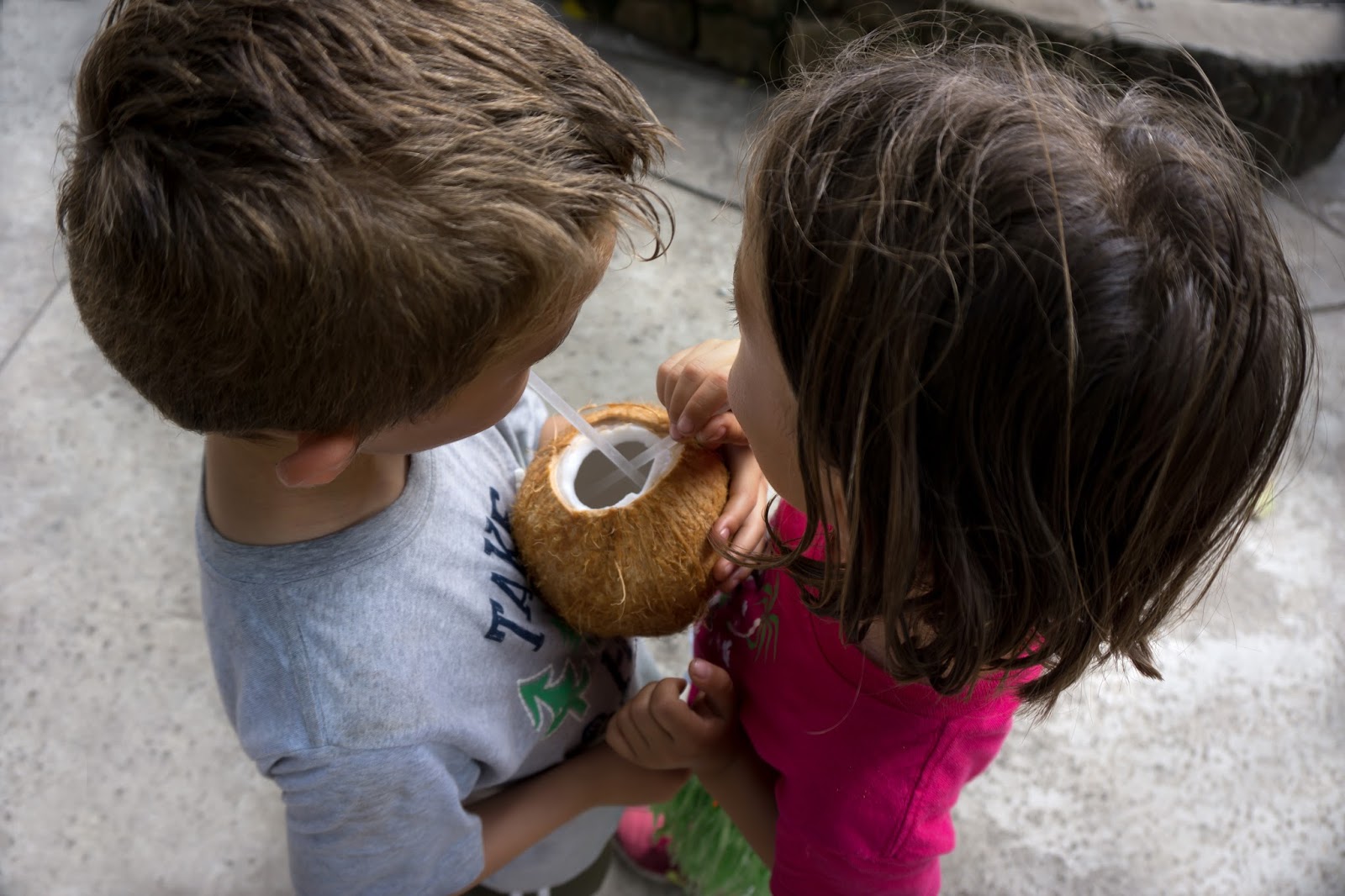
When we came back a couple days later, we found out that the hip shaking hula is from Tahiti. Hawaiian dancing is a slow moving, hypnotic type of movement. At the Fiji island, the kids bought an ice cold, FRESH coconut from a man who hacked it open with a machete type knife. The water inside came all the way to the top. After we drank that, he scooped out the fresh meat which was more like a slightly chewy, jello-like consistency. That's when I realized I'd never had a fresh coconut before. He said if you can hear it slosh when you shake it, it's not fresh. Aha!


A cute side story- In an attempt to limit paper towel use, we ask the kids to only use one paper towel because we don't want to waste paper and cause more trees to be cut down. He quickly began monitoring everyone's paper towel usage and getting upset if someone used two. He would explain, "if you use two, they cut down palm trees and I love coconuts!" Haha!

Here is where we learned the slow-moving Hawaiian hula. 

Afterwards Journey treated us to her own hula dance while the band continued to play behind her.


My Hawaiian Journey showing the way to the Center's Hawaiian Journey. 

Learning how to use the poi balls from New Zealand's Maori people. They have their 
own now and are still trying to learn how exactly to duplicate what they saw.